Which type of video does your company need?
Corporate video covers very different formats, and choosing the right one shapes everything that follows. A brand film — known in Austria as an Imagefilm — introduces who you are and what you stand for, usually for your website, trade fairs and presentations. Employer branding videos show what it is like to work with you, aimed at people you want to hire.
Event aftermovies capture the energy of a conference, a summer party or a product launch and are used to promote the next edition. Social reels are short vertical clips built for specific platforms and attention spans. Many companies need several of these, which is a good reason to plan them together.
- Brand film (Imagefilm): website, trade fairs, sales meetings
- Employer branding: careers page, job ads, recruiting events
- Event aftermovie: recap for attendees, promotion of the next event
- Social reels: short vertical clips for regular posting
- Explainer or product video: how something works, for customers
Step 1: Define the goal and the audience
Before talking about cameras or styles, write down in one sentence what the video should achieve and for whom. “Help engineering graduates in Graz understand why our team is a good place to start a career” leads to a very different film than “show potential clients in Vienna how reliable our service is”.
Decide where the video will live and what the viewer should do afterwards — apply, get in touch, sign up, remember your name. That determines the length, the tone, whether you need subtitles in German and English, and which formats to deliver.
Step 2: Script, interviews and storyline
Most strong corporate films are built around real people speaking in their own words, supported by footage of the work itself. A production partner will usually help structure interview questions and a rough storyline, then shape the final narrative in the edit.
If the film relies on a voice-over or exact claims, write and approve the script in advance. Involve whoever must sign off — management, marketing, legal — early, so the edit does not stall over wording at the end.
Think carefully about who appears on camera. The most senior person is not always the most convincing storyteller; people from the workshop, the lab or customer service often come across as especially credible. A short preliminary chat helps them relax and shows who enjoys speaking.
Step 3: Locations and the shooting schedule
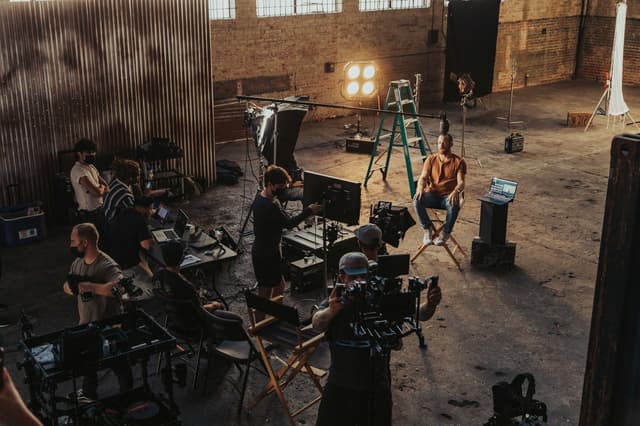
List every location: offices, production halls, a client site, an outdoor shot of your building. For each, clarify who grants access, whether there are safety rules such as protective gear in a factory in Linz, and the best time of day for light and minimal disruption.
A realistic schedule includes set-up time, which is longer than people expect, and short slots for each interviewee so they are not kept from their work. Filming on public ground or in someone else’s building can require permission from the owner or the city, so ask about this in good time.
Making the most of one production day
Getting a crew, lighting and your team in one place is the biggest effort, so use it well. A single well-planned day can often produce the main brand film footage, several short social clips cut from the same material, and a set of team headshots in a corner set up for portraits.
Plan headshots as a separate station with a photographer, so people can drop by between meetings. Shoot vertical versions of key moments for social channels at the same time rather than cropping later. Make a list of every output you need before the day — it is far cheaper to capture an extra shot than to organise a second shoot.
Consent and data protection
Footage of clearly recognisable people counts as personal data under the GDPR (in German, DSGVO), and those people have rights over how their image is used. In practice, get written consent from employees, customers and anyone else who appears prominently, and explain where the video will be used and for how long.
For events, inform attendees in advance that filming will take place, for example in the invitation and with signs at the entrance, and offer a way to opt out. Rules can be nuanced, especially for employees, so check your approach with your data protection contact or legal advisor rather than relying on general advice.
Drone shots for companies
Aerial footage is ideal for showing the scale of a production site, a building in its landscape or an outdoor event. Drone flights in Austria are regulated, and operators must comply with requirements administered by Austro Control; urban areas, airports and some sites have additional restrictions.
Work with a filmmaker who handles registration and checks the specific location, and allow time for any approvals. If it turns out a flight is not possible, a high vantage point or a crane-style shot can often achieve a similar effect.
How to brief a production
A good brief saves time and makes quotes comparable. It does not need to be long; one or two pages covering these points are enough to get meaningful proposals:
- Goal, audience and where the video will be published
- Formats and lengths: main film, cut-downs, vertical clips, photos
- Locations, preferred dates and any access or safety rules
- People on camera and whether consent is already arranged
- Language versions and subtitles
- References you like, and things you want to avoid
- Deadline for delivery and who approves the edit